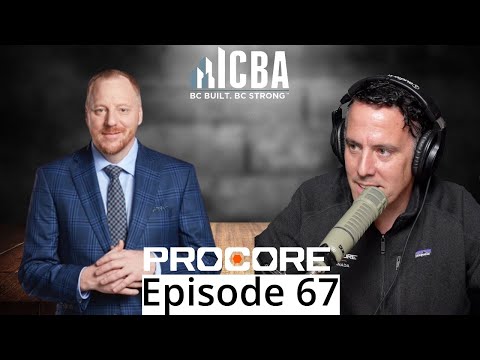
Corey Hirsch — Olympic silver medalist, NHL goaltender, and ICBA mental health speaker — has brought his story to roughly 15,000 construction workers across BC and Alberta. His message: the construction industry's suicide rate runs five times the national average, and leaders who keep the tough-guy culture own that number.
Corey Hirsch drank from the Stanley Cup in 1994. He had an Olympic silver medal from Lillehammer. By any measure he was living the dream. He was also, by his own account, suicidal — with undiagnosed OCD he'd been hiding for years.
He sat on that secret for three to four years. Lost 30 pounds. Attempted suicide. Got bounced to the minors. Eventually got treatment, eventually went public — first with a 4,500-word Players' Tribune essay called Dark, Dark, Dark that got two million hits in under an hour, then with a 2022 memoir, The Save of My Life, published by HarperCollins Canada. Now he tours construction sites across BC and Alberta as an ICBA Wellness Ambassador, having spoken to roughly 15,000 workers.
The reason it maps to construction is uncomfortable and exact. This is a 70–90% male industry with a culture that runs on physical toughness, silent endurance, and not complaining. And "the suicide rates of construction is five times the national average" — that is not a soft statistic. It is a body count.
Mental health is a safety issue, not a morale issue
The frame Hirsch uses with construction crews is one they already understand: safety. A worker who is struggling — depressed, not sleeping, self-medicating — is not operating at full capacity on a dangerous site. That is a hazard to the crew around him. If your culture shames people out of getting help, as Hirsch puts it, "you're actually encouraging a safety issue"
That reframe matters because it removes the soft-program stigma. A foreman who runs toolbox talks on fall protection and lockout/tagout is already doing safety. Mental health belongs in the same conversation, for the same operational reason: a compromised worker creates risk.
The top three drugs requested by ICBA members through their benefits programs are for depression, anxiety, and sleep disorders. That is the actual condition of the workforce. The bravado on the surface does not change what's underneath.
What the tough-guy culture actually costs
Hirsch's own story is the data set. He had every external signal of success while he was quietly losing the thread. The NHL career that should have run longer got eaten by three to four years of suffering in silence. He is direct about what getting help sooner would have changed: "if I could have gotten help right away" — that is the version of the story that does not end with a decade detoured.
For site leaders, the ask is concrete. First: announce an open door. Tell your crews explicitly that you want to hear about it, not in a poster on the wall but out loud. "have an open door policy because it affects everybody" — second: know the referral chain. The first stop is the family doctor — "the first place you go is your doctor right your doctor has seen all of it" — and doctors route to psychologists and psychiatrists. Third: point your crews to what already exists, because "there are programs now available and just get in touch with them" through HR departments and employer/union assistance programs. Most workers do not know to use them.
None of this requires a company to become a therapy practice. It requires a foreman to say, out loud, that the door is open.
Keep the banter. Add the check-in.
One of the more useful things Hirsch says is that you don't have to change the culture of a construction site to do this well. The ribbing, the nicknames, the dark humour that gets a crew through a hard winter — none of that has to go away. What has to change is one thing: being the person your buddies know they can actually come to.
The practical instruction is to watch for excess. When someone on your crew is drinking more than usual, using more than usual, there is almost always something underneath. "just check in with your buddies" — he says, and when it looks serious enough, "if it's bad enough right it's time to have a conversation" Direct, not confrontational. You're not diagnosing anyone. You're opening the door.
Hirsch watched this dynamic from both sides — as a professional athlete in a locker room that punished vulnerability the same way a job site does, and as someone who eventually learned what silence costs. He lost a girlfriend to suicide. He has seen what the destruction looks like on both ends of it.
When leaders share their own struggles, it has a measurable effect: "when you share your story it actually helps someone else open up" — that is not a feel-good principle — it is how the referral chain actually starts on a job site. Someone hears that the superintendent went through something and got help. Someone junior decides to make the call.
What a healthy workplace does for your books
This is also, bluntly, a retention argument. People who are treated well, who feel like they can bring problems forward, do not leave. They work hard for you because they want to, not because they're afraid. Hirsch is plain about it: "people are going to want to work for you they're gonna want to work hard for you" — in a labour market where every contractor in the country is fighting to hold their crew together, that is not nothing.
Bullying and mistreatment exist in professional sports and they exist in construction. Workers stay silent about it because their paycheque depends on it. An employer who eliminates that silence — who makes it safe to raise a problem — retains workers that a bully company loses. Keeping the people you've already trained starts with making the site a place they want to be.
Secrets are toxic
Hirsch's Players' Tribune piece got two million hits in under an hour, which tells you something about how many people recognized the experience and had never seen it named out loud. His book is a mental health story with hockey as the wrapper, not the other way around.
The lesson he draws from going public is direct: "secrets are toxic and people make up their own assumptions" — when you are off your game and you say nothing, the people around you fill in the blank, and what they invent is usually worse than the truth. Saying something — to a doctor, to a supervisor, to a friend — is the intervention that breaks the loop.
Parents and owners who model this set the norm the next generation follows. As Hirsch puts it, "set the example example that it's okay to go get help" — awkward phrasing, real instruction.
He closes on a note that travels from the 1994 Rangers to construction companies: know your role. Organizations win when everyone does their current job instead of coveting someone else's, and "your best chance of success is to know what your role is within that company" — and to be present enough to do it.
If someone on your crew is not present, now you know what to do about it.
About the sponsor: Procore Technologies
This episode was sponsored by Procore, a publicly traded cloud construction-management platform (NYSE: PCOR) that connects owners, general contractors, and specialty contractors across the full project lifecycle — preconstruction, project execution, financials, quality, and safety. Procore is a software vendor; it does not self-perform construction work. If your company is managing projects across multiple sites and still running on spreadsheets and email chains, their platform is worth a look.
Guest: Corey Hirsch, NHL Alumni mental health advocate and ICBA Wellness Ambassador. Episode sponsored by Procore Technologies. ICBA (Independent Contractors and Businesses Association of BC) represents 4,500+ open-shop contractors in BC and Alberta and delivers wellness programs to the construction sector — icba.ca. Hirsch's Players' Tribune essay: Dark, Dark, Dark. His 2022 memoir: The Save of My Life. Watch the full episode.