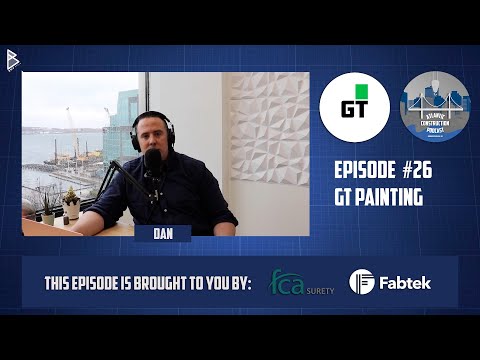
GT Painting founder Guillaume Tremblay put the sub-trade perspective on record: chronic underpayment, no apprenticeship pathway, scope that grows while prices shrink, and a 12-month wait for a final cheque. If you work in finishing trades anywhere in Atlantic Canada, this is your conversation too.
There is a specific kind of cash-flow stress that most people in construction never have to feel directly. You price the job, win it, mobilize your crew, buy the materials, pay the wages — and then you wait. Not days. Weeks, sometimes months. On one project Guillaume Tremblay ran, the wait stretched over a year. “there's one project we waited over a year for to get our final payment to come through”, he says, matter-of-fact, the way you say something you've already spent too much energy being angry about.
Tremblay is the president and founder of GT Painting, a commercial and residential painting contractor serving Nova Scotia and New Brunswick. He grew up around the trade — grandfather a painter, father a painter — tried to escape it through an accounting degree at Saint Mary’s, found himself running a painting operation for a local contractor while still in school, spent two years in financial services at Citco, and then came back. He incorporated GT Painting with a partner in 2014. By the time he sat down with host Daniel Arsenault, the company had grown to nearly 40 people at peak, with two project managers, an estimator, and site leads across a mix of residential, multi-unit, and commercial work.
The episode is 45 minutes of unsentimental accounting of what it actually costs to run a painting sub-trade in HRM. Not many contractors go this public with this level of specificity. It’s worth reading carefully.
Sub-trades are the last ones paid — and the first ones squeezed
The structural problem Tremblay describes is not unique to painting, but painting sits at the sharpest end of it. Painters are the last trade on site. Everyone ahead of them in the schedule — framing, mechanical, electrical, drywall — has to finish before a painter can start. When any of those trades run late, the schedule doesn’t extend; it compresses at the back. The painter absorbs it.
“we've been backed into the corner and say you have to — this is your fault because someone three months ago didn't meet their schedule”, Tremblay says. That compression doesn’t come with a compensating change order. It comes with the same contract price, a tighter deadline, and the implicit threat that the relationship is over if you push back too hard.
Then there is the payment chain itself. The client pays the general contractor. The GC pays the sub. At each link, there is float — money sitting with the party above before it moves down. By the time it reaches the sub, the project might have been substantially complete for months. “we are the banks of the construction the sub trades as a whole we put out the labor we put out the material and we sit and wait”, Tremblay says. That is not a complaint — it is a structural description. If you run a sub-trade and you haven’t modeled your working capital requirements against the worst-case payment timeline on your biggest active job, you are one slow-paying GC away from a crisis.
The market that grinds prices down
HRM’s painting market has a specific reputation that Tremblay confirms from his own paint-company reps: it is, by their account, the most price-competitive painting market in Canada. “hrm overall in canada is probably the most competitive paint industry not just for price points but also for the cost of paint”, he says. Low barriers to entry — anyone with a brush and a van can bid — combined with a deep roster of small operators creates a permanent race to the bottom on tender work.
The irony Tremblay identifies is that the cost of living in Halifax has gone up substantially. The cost of materials has gone up. Wages have had to go up to compete with other trades for workers. But painting rates have not kept pace. The margin compression is real, sustained, and, without collective action, self-perpetuating: every operator who bids low to win work validates that price for the next round.
This is the context for GT’s portfolio diversification. “right now i feel like we have probably the best mix of all three and it's kind of helped us out through the pandemic”, Tremblay says of the company’s spread across residential, multi-unit, and commercial. A commercial pipeline with several projects moving at once smooths cash flow in normal conditions; residential and multi-unit provide volume that doesn’t depend on winning public tenders.
Scope that grows, prices that don’t
A generation ago, a painter painted. Today, Tremblay explains, the scope has expanded to include caulking, patching, and repairing damage that other trades caused. None of that expansion has come with a corresponding increase in the painting line on the budget. It has simply been absorbed.
“the expectation that the painters will fix it the painters will fix it and it's the trickle-down effect”, he says. Damage from the trades ahead of them — scuffs, dents, gaps, tool marks — lands in the painter’s lap as an unstated assumption that the finishes will be delivered clean regardless of what condition the substrate arrived in.
The asymmetry goes further. When a painter accidentally damages another trade’s work — a cut wire, a scratched fixture — that trade bills back for it. When another trade damages painted walls, the painter cannot recover the cost. “if we get a damaged wall it's like well that's you you should have that in your quote to fix that”, Tremblay describes as the response. Electricians get a back-charge mechanism. Painters don’t. That is a contractual gap that general contractors could close if they chose to enforce it consistently.
For sub-trades reading this: the scope-creep exposure is real and cumulative. Price a damage allowance into every commercial bid, or absorb the loss. Get the back-charge language into your sub-trade agreement, or accept that you will never collect on it.
Why the workforce problem will not fix itself
The deepest structural issue Tremblay raises is the absence of any formal painting apprenticeship program in Nova Scotia. The Red Seal exists, but it is now administered online with no hands-on component — a credential that confirms time served but does not certify skill in any meaningful way that clients or employers can rely on.
Without a credentialed pathway, hiring is guesswork. “you're forced at the end of the day to try to kind of give everybody a try and it's creating a lot of issues”, Tremblay says. Years of experience on a resume mean nothing if there is no standard they were trained against. The only reliable filter is a paid trial, which costs money every time it fails.
Retention is the harder problem. The painting trade has almost no institutional pressure to stay employed — no journeyman structure, no seniority ladder that means anything in the absence of a formal trade designation. “nine times out of ten the minute you become good you go off on your own and start doing your own thing”, Tremblay observes. The best workers leave. The cycle repeats.
His proposed fix is a formal NS apprenticeship for painting. “that certification would prove that we're painters and we're certified and we're willing to do good work”, he says. He names a contact at the Nova Scotia Apprenticeship Agency — Ebenezer — as someone he intends to pursue this with. Without a credential, the trade has no psychological barrier against casual entry, no quality floor, and no professional identity that makes skilled workers feel the career is worth staying in.
Silence perpetuates the bottom
The episode is itself an act of advocacy. Tremblay is frank that painting contractors in HRM have not historically communicated with each other about industry-wide problems — even with competitors, even informally. “there's not enough action being taken and coming here today is kind of maybe a starting point for me”, he says of his decision to go on record.
The logic is straightforward. In a small, competitive market, every operator who stays quiet about unsustainable pricing validates it. Collective conversation among competitors — about what finishes cost to deliver properly, about what a fair labour rate looks like given actual cost-of-living pressures — is the only mechanism that can move a pricing floor without individual operators taking on career-ending financial risk. Trade association activity, apprenticeship advocacy, and the occasional frank public conversation are not soft industry citizenship. They are operating strategy.
The exit from the commodity grind
GT’s forward strategy is not to win more commercial tenders. It is to reduce exposure to them. Tremblay’s pivot has two legs: high-end decorative coatings and pool coatings.
On the coatings side, he describes investing in multi-step application techniques — he references a 12-step process — that most Halifax contractors do not offer. “there's a couple courses i'm going to take on a high-end product that i don't think is pretty common here”, he says. Pool-coating certification is the second track: a credentialed specialty that opens residential work at better margins with clients who cannot shop price the same way they can on a standard interior paint job.
The relational strategy underneath both is a deliberate narrowing of the client base toward people who treat the relationship as one. “focus on the relationships that really matter during the day that when we're done they go thank you so much for that”, Tremblay says. That is not sentimentality — it is a selection criterion. A GC or developer who says thank you at job completion is one who respects the schedule, honours the contract, and pays without a 14-month chase. Find more of those. Spend less time winning tenders from people who don’t.
The builders featured in this episode
GT Painting Inc. is a Halifax-based painting contractor operating across residential, commercial, and new-construction sectors in Nova Scotia and New Brunswick. Its team-based model includes dedicated estimators and project managers; it handles interior and exterior painting, taping, drywall finishing, wall coverings, and faux finishes.
Also referenced: RCS Construction, the Atlantic Canadian general contractor that has worked with GT Painting across commercial projects including the Glen Arbor build and the Halifax Shopping Centre renovation. Dexel Developments, the Halifax-based vertically integrated design-build firm, is among the named project relationships in the episode. Twin City Painting (1979) Limited is the other established commercial painting contractor named in the conversation as a peer in the HRM market.
Guest: Guillaume Tremblay, President & Founder, GT Painting Inc. — Episode 26 of the Atlantic Construction Podcast. Watch the full episode.